Maritime
Inspect at sea, sync ashore, and keep an audit trail every auditor can follow. From the first finding to the dry dock.
On board there is often no connection, and yet things have to be checked: engine room, deck, safety equipment, accommodation. What is recorded on paper or in loose photos has to be retyped ashore, and what happens to a finding gets lost between two ports.
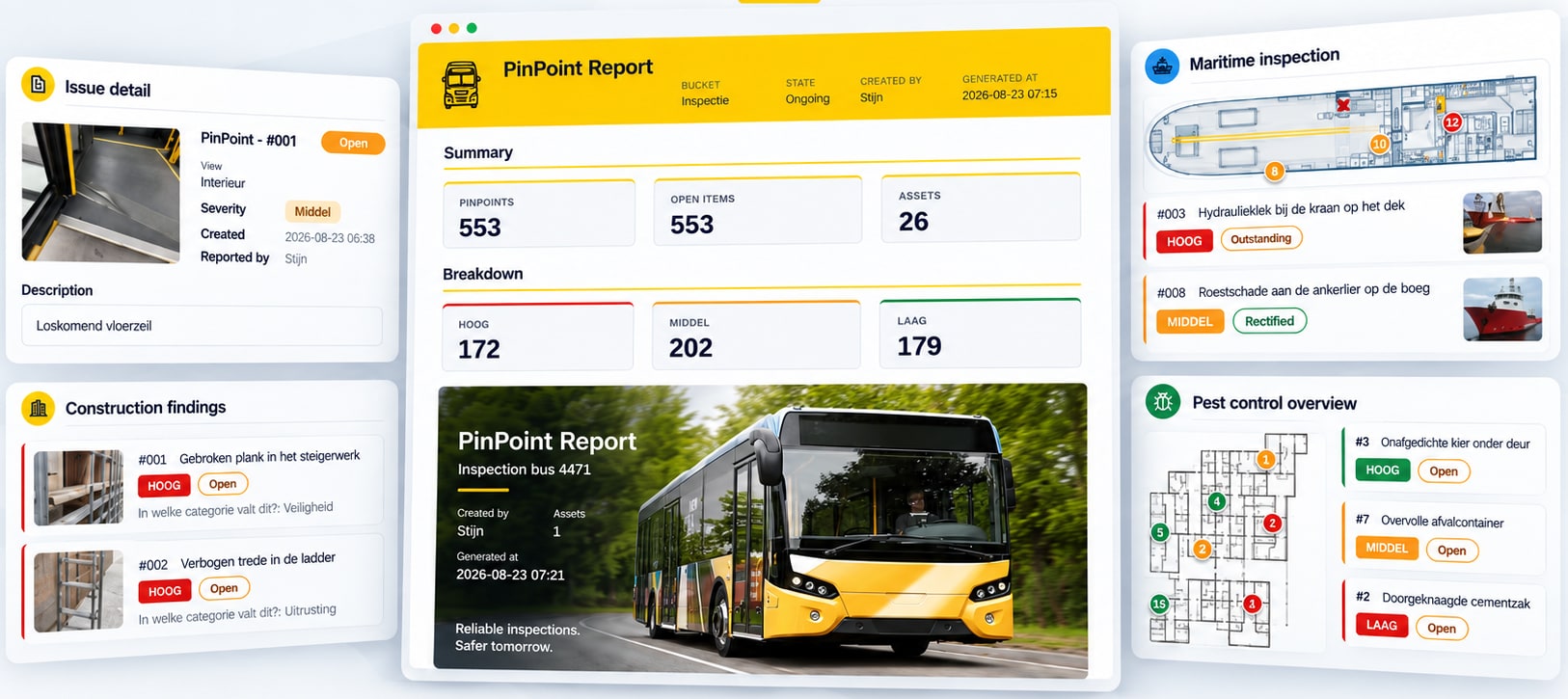
PinPoint works offline on tablet and smartphone. The crew records findings on the ship's plan, with photos and a structured questionnaire, and as soon as the ship has a connection ashore, everything syncs. Every change is kept, with who, when and why.
Time is money
Every day in dry dock costs a lot of money. Whoever arrives with a list where every open item is ready, with location, photos and severity, spends those days on repairs instead of on searching.
A shipping company we work with came with four requirements. Together they describe quite precisely what makes inspections at sea different from those ashore.
Offline on board. Check everything without a connection, and sync everything as soon as the ship comes ashore.
A complete audit trail. For the external audits the company undergoes: who recorded, changed and closed what, and when.
Structured questionnaires. With a follow-up flow: not only what was wrong, but also how the problem was solved and who checked it.
Reports that hold up. For the auditor, the class society and management, from the same data.
And a benefit that only shows after a while: because every finding is structured, the company sees which problems keep coming back, on which ship and in which installation. That history is the basis for planning maintenance before something fails, instead of after.
History.
Per ship and per installation you see what was found before, how it was solved and by whom.
Patterns.
Which problems keep coming back, on which ship and in which installation, so you tackle the cause instead of the effect every time.
Respond.
Steer an item with an owner, a priority and a deadline, so on board and ashore everyone knows what is expected of them.
Under the rules of the classification societies (IACS UR Z3), the ship's bottom is examined at least twice in each five-year period, with at most 36 months in between, normally in dry dock. Every day there costs a lot, so that time has to be used as efficiently as possible.
All open findings of the past months are ready, per zone of the ship, with photos, severity and history.
The yard gets a work list on the ship's plan, not a pile of loose reports that first need sorting out.
Every item is ticked off at the spot where it is, with a photo of the repair.
A report of what was done, and an audit trail that shows who closed each item.
The audit trail was the starting point of the architecture, not a feature added later. An auditor wants to see not only that something happened, but also why, by whom and in which order.
Everything is logged.
Creating a finding, every status change, every photo and every answer.
Every change with who, when and why.
You always know who did what, even months later.
Nothing is overwritten.
The current state is derived from those events. A correction stays visible as a correction.
One source.
Report, dashboard and audit trail come from the same data, so they cannot contradict each other.
Checked in September 2026:
PinPoint is inspection software, not a classification society or recognised organisation. It records what is found and done on board, in a form that fits these audits. Whether a ship or company complies is decided by the auditor, the class society and the flag state.
A ship inspection is a check of the condition of a ship and its equipment: hull, engine room, safety and life-saving appliances, deck and accommodation. It is carried out by the crew and the company itself, and also by the class society, the flag state and Port State Control. Every finding gets a location, a severity and a follow-up, so an audit can show what was found and done.
Yes. The app works offline on tablet and smartphone. The crew records findings, photos and answers as usual, and everything syncs as soon as the ship has a connection again ashore or in port. Nothing gets lost between two ports, and nobody has to retype anything ashore.
Yes. Every event is kept: creating a finding, every status change, every photo and every answer, with who, when and why. Nothing is overwritten, so an auditor can follow the full course of each item, right up to who closed it.
Yes. All open findings are ready per zone of the ship, with photos, severity and history. The yard gets a work list on day one instead of loose reports, and every repair is ticked off on the spot. That saves time in a place where every day costs a lot.
The data is the basis for it. Because every finding is structured, you see which problems keep coming back, on which ship and in which installation. Through export, Power BI, the API or the MCP server, that history feeds your own analyses or maintenance planning.
We will be honest with you. If PinPoint is not the right fit, we will tell you. No hard sell, no obligations. Just a conversation between people who understand inspections.
Last updated on